The Night Sky October 2026
Our days are now noticeably shorter, more timer, weather permitting, for astronomy whether visual or imaging. Don’t forget to put your clocks back at the end of the month when we will switch from BST to UT (Universal Time or Greenwich Mean Time)
The above link is an excellent site for the latest information on what to see as well as containing a live planetarium. You can also set the time ahead and back to show where celestial objects were or are at the time set.I have used this for the star charts showing planet locations.
For anyone observing the Sun in white light you will have noticed that there are fewer and fewer large sun spots and generally what there are are smaller. That means we are coming towards the end of the current 11 year cycle.
It does not always mean no more aurora as the Sun has a constant action that can still produce CME’s (coronal mass ejections) which are a second source of ejecting matter.
The Moon
We start the month with a waning gibbous Moon with the new phase starting on the 11th and reaching full face on the 26th October.
On the morning of 7th October the sliver of the waning Moon will be just south of Regulus in Leo making a nice pairing.
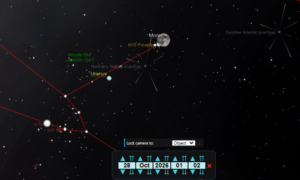
Over the 27 & 28th October the near full Moon will transit across the Pleiades, the transit starts at about 23:45 UT on the 27th and ends at around 02:30 UT on the 28th, note the time changes as we are back on Universal Time. The timings are approximated as mt data uses London as a location and of course we are North of the capital.
Meteor showers.
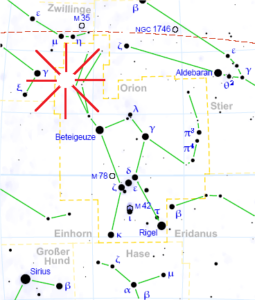
The Orionid meteor shower commences on the 2nd October and lasts until the 7th November. The cause of this shower is the trail of debris left by the 76 year cycle Halley’s comet. Its radiant point is shown below close to the raised arm of Orion. However it does move from above Orion’s head out to his arm over the period.
The Orionids peak on October 21st, however the Moon will be waxing and gibbous.
The Planets
Mercury: Is very low in the evening sky, observable only from flat locations like the Fens…
Venus: Like Mercury it is low, just above a degree before sunrise.
Mars: A morning object and getting easier to see. Reaching 42°
Also on 5th October at 2:30 BST the Moon will be around 1.4° NW of Mars, that’s roughly 3 Moon widths
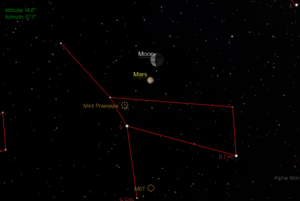
Makes an interesting passage through M44 the Beehive Cluster over the 11th & 12th October, best seen around 02:00.
Keep watching and at about 05:50 BST Mars and the Moon will be just 40 arcminutes apart.
Jupiter: Is a morning object and on the 6th October at about 06:00 BST the Moon will be 2.5° NW of Jupiter, it will pass much closer but the dawn will be fast coming.Heads up! In November they will get closer…..
As you can see it does not reach its peak altitude and will be lost in the sunrise.
Heads up! In November they will get closer…..
https://theskylive.com/galilean-moons
The above link will give you a live view of the Jovan moons positions to help you identify them.
Saturn: Can be found in Cetus the whale from the start of October and if you are up at 01:00 BST on the 4th October it is a good time to view it.
It’s rings are opening up again and under good seeing you should be able to make out the Cassini division in the rings.
It is coming into opposition and that means the rings get brighter than a week before and after opposition.
https://theskylive.com/saturn-rings-and-moons
Again the above link will provide the details on the Saturnian moons positions.
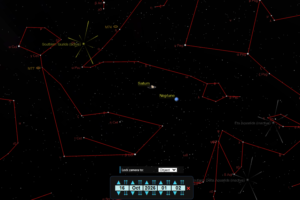
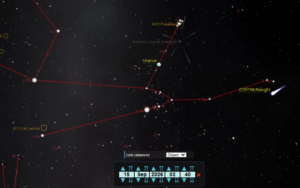
Uranus: An early morning planet at mag +5.6 lies between Taurus and the Pleiades.
Neptune: At mag +7,8 a telescope is needed to see Neptune making maximum altitude of 37° on 1st October at 00;40 BST
The stars:
The Milky Way will be overhead which means the densest part we see in the northern hemisphere will be nicely visible to those with a darker sky. Running through Cygnus in the west, Cassiopeia directly overhead and down to Auriga in the east.
Andromeda and its galaxy will also positioned high in the sky which offers good opportunity to view and image M31 our closest galactic neighbour.
For those of you up around midnight will see the Pleiades rising in the east, followed by Taurus.
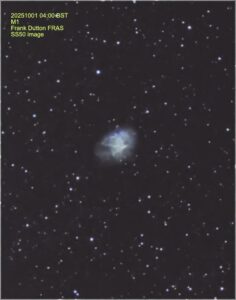
Taurus and the Pleiades will now be with us until February 2027. While looking at the Pleiades have a look at the head of Taurus the Hyades. Both are stunning in a pair of binoculars. Below a quick image of M1 in Taurus taken on 1st October in 2025.